
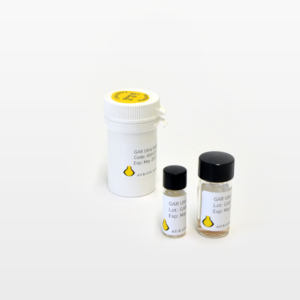
Aurion Ultra Small Immunogold Reagents are prepared with sub nanometer gold particles. These particles have far less influence on the adsorbed antibodies or detecting molecules, and consequently the conjugates behave as though they are uncoupled. In conjunction with the highly efficient and easy-to-use R-Gent SE-LM and SE-EM silver enhancement reagents, the Ultra Small Immunogold Reagents are the best choice for any application.
Introduction to ultra small gold nanoparticles
Reduction of the gold particle size provides Ultra Small Immunogold Reagents with fundamentally different characteristics when compared with conjugates built around larger particles. While the Conventional Immunogold Reagents can be thought of as particles coated with proteins, Ultra Small Immunogold Reagents are proteins coated with one or more gold particles. With this structure, both the overall size of the conjugates, as well as steric hindrance are decreased.
The table below lists a few physical characteristics of gold conjugates.
| Particle diameter | #Au atoms | MWt. (daltons) | #particles /ml | #Ab /(part.) |
|---|---|---|---|---|
| 0.8 nm | 15 | 3·10^3 | 5·10^15 | 0.1-1? |
| 6 nm | 6500 | 1.3·10^6 | 2.4·10^13 | 1-2 |
| 10 nm | 30·10^3 | 6·10^6 | 5·10^12 | 7-12 |
If you have a question or need more information, do not hesitate to contact us or check our FAQ section.
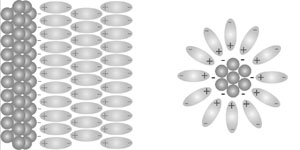
The small gold particles also have a tight particle surface curvature which makes it less likely that a structured water dipole layer will build-up around the gold particles. Hence, the hydrodynamic radius of the ultra-small gold colloids is reduced. Finally, small gold particles carry less net negative charge; thus, they undergo less charge determined repulsion when approaching the sample surface.
Aurion offers Ultra Small nanoparticles with an average gold particle diameter of 0.8 nm or less. These ultra small gold nanoparticles can be visualized directly in high angle annular dark-field-scanning TEM. However, the gold signal is normally visualized after increasing the particle diameter with silver enhancement. The reagents can be used in electron and light microscopy as well as in blotting experiments. The universal applicability makes it easy to compare results obtained with different procedures.
Product Description
AURION Ultra Small Immunogold Reagents contain 60-80 µg of specific protein/ml for IgG conjugates. F(ab’)2, Fab and biotinylated albumin conjugates contain equimolar amounts of conjugated protein. The average gold cluster diameter is less than 0.8 nm.
AURION Ultra Small Immunogold Reagents are used in conjunction with AURION R-Gent SE-EM or SE-LM silver enhancement reagents, developed for electron microscopy and light microscopy/immunoblotting, respectively.
The reagents are supplied in PBS with 1% Bovine Serum Albumin and 15 mM NaN3.
The activity of each lot is determined using a dot-spot test system as described by Moeremans et al., J. Immunol. Methods, 74, (1984), 353.
The products are available in two package sizes:
Regular package: for 1200 grids or 600 slides
Small package: for 480 grids or 240 slides.
Application Instructions
Detailed information is provided in the package inserts.
Electron Microscopy
Post-embedding Labeling
Incubate thin sections by placing grids on drops of reagent arrayed on a sheet of Parafilm™. The use of nickel grids is recommended, especially if silver enhancement procedures are intended.
Pre-embedding Labeling
Float specimens in dilute reagent on a rocking table.
There is a special word on pre-embedding in the “sharing our knowledge” section of this website as well as a Newsletter (free copy on request). The incubation protocol on pre-embedding can be found in the section “the Aurion method.”
Light Microscopy
Slide or Coverslip Labeling
Apply a few drops of dilute reagent to cover the specimen.
Recommended Incubation Solution:
PBS,
(10 mM Phosphate buffer, 150 mM NaCl)
0.1-0.2 % AURION BSA-c™
15 mM NaN3
pH 7.4
Note on background prevention:
A special AURION NEWSLETTER dealing with the topic of background is available on request.
A special AURION NEWSLETTER describes the use of AURION Ultra Small Immunogold Reagents in pre-embedding labeling. A free copy is available on request.
Specificity
Aurion offers the widest range of Ultra Small Immunogold Reagents. The most used reagent types are available as intact IgG, F(ab’)2 and Single Fab conjugates. Please refer to ‘Ordering Information’ for a complete list of reagents available.
AURION Ultra Small Immunogold Reagents are prepared using the highest quality antibodies or binding agents available. All antibodies are immuno affinity purified and immuno cross-adsorbed to reduce non-specific interactions.
Storage
AURION Immunogold Reagents have a guaranteed shelf life of 18 months from the date of quality control analysis.
The products should be stored at 4-8°C. Freezing is not recommended.
Elevate your research
Unlock the full potential of ultrasmall gold nanoparticles with Aurion’s high-quality immunogold reagents and silver enhancement solutions. Aurion, renowned for its commitment to excellence, offers an extensive selection of products, including USGNPs and advanced signal-to-noise immuno-enzymatic solutions, all designed to meet the rigorous standards of modern laboratories. Place your order today and elevate the precision and reliability of your research.